

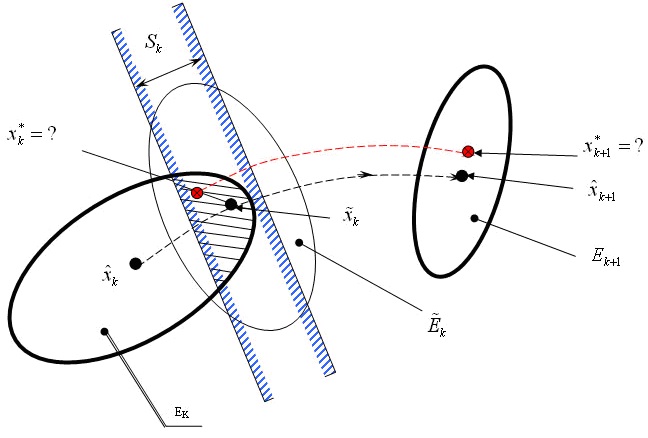
Within this research area, we address control problems for a broad class of linear and nonlinear discrete, continuous, and hybrid dynamic systems (DS) under conditions of uncertainty. Uncertainty in DS is defined as ambiguities in the available information regarding the state vector and parameters, as well as uncontrolled measurement noise and external disturbances.
Currently, methods based on a probabilistic interpretation of uncertainty are widely used to solve dynamic system (DS) control problems. However, these methods require extensive a priori information about the probabilistic properties of uncertainty, which is often only approximately known to control system developers. Moreover, they are critically sensitive to discrepancies between the true properties of uncertainty and their a priori assumed characteristics. The necessity of solving complex control problems, driven by the advancement of high technologies, has led in many cases to a shift away from common probabilistic models toward set-theoretic models of uncertainty. In modern control theory, an approach known as the guaranteed approach is being intensively developed. This approach focuses on creating control and estimation methods based on set-theoretic models. Here, the properties of uncertain quantities are more naturally defined by guaranteed intervals (as is common in mechanical engineering and instrumentation) or compact sets of their possible values. Convex polyhedra or multidimensional ellipsoids in corresponding spaces are used as set estimates.
The foundations of this approach were established in the works of N.N. Krasovskiy and F.C. Schweppe. Significant contributions to the development of guaranteed estimation methods were made by A.B. Kurzhanski, F.L. Chernousko, V.M. Kuntsevich, B.N. Pshenichny, M. Milanese, J.P. Norton, and others, including researchers from Department 21 ‘Dynamic Systems Control’.
The rejection of the hypothesis regarding the stochastic nature of uncontrolled disturbances and noise, coupled with the utilization of only certain a priori set estimates, has led to the emergence and rapid development of a new direction in the theory of dynamic system identification and state vector estimation: the development of guaranteed estimation methods.
The foundational works in this field were conducted by Academicians N.N. Krasovskii and A.B. Kurzhanski, and further advanced by Academicians F.L. Chernousko, V.M. Kuntsevich, and B.N. Pshenichny. By the late 20th century, it became critically clear that since control system designers have access only to certain estimates of an object’s parameters, they effectively face the task of controlling not a single fixed object, but an entire family (or class) of objects. In this scenario, the control strategy must ensure the stability of the entire family (or class) of such systems, thereby achieving robust stability.
Currently, the theory of such stability is, naturally, most developed for linear systems (both continuous and discrete), where significant results have already been achieved. A more critical and challenging fundamental task is the development of a corresponding theory for specific classes of nonlinear systems, as well as the construction of their reachability sets and limit sets.
The reachability sets of a DS are understood as sets into which its state vectors fall at an arbitrary current time under all initial conditions, control vectors and external disturbances belonging to certain given sets (trajectory tubes). The limiting set of a dissipative DS is understood as sets into which all its phase trajectories fall and remain under arbitrary initial conditions, or initial conditions from some limited region of the phase space (for DSs that are dissipative in the region). The dimensions of the limiting set determine the accuracy of DS control in steady-state regimes.
Within the framework of this approach, the Institute for Space Research of the NAS of Ukraine and the National Space Agency of Ukraine have first developed methods for guaranteed ellipsoidal estimation of the state and parameters of the DS, which have the property of robustness (insensitivity) to the difference between the a priori estimates of the uncertainty properties used in these algorithms and their actual properties.
It is thanks to this property that robust methods of guaranteed evaluation retain their efficiency in many cases when known methods become inconsistent. Theoretical research, practice of developing systems for controlling technological processes and spacecraft orientation, and the results of data processing of space experiments have confirmed the effectiveness of the guaranteed approach to solving control and evaluation problems under uncertainty and the prospects of its application in spacecraft control problems. Based on the above-mentioned robust methods, navigation and orientation control algorithms for the EgyptSat-1 microsatellite, developed by Ukrainian enterprises by order of the Egyptian government, were created.
Further development of methods for assessing the state of nonlinear DS based on polyhedra is being carried out and is planned. In this case, the method of specifying a polyhedron using systems of inequalities, which requires less computational effort and previously proposed by its authors – employees of the department, will be used. In addition, this method allows, during the algorithm operation, to constructively detect errors in assumptions about a priori properties of uncertainty and reject measurements with errors.
To solve the problems of assessing the state and parameters of the DS, it is also planned to use and develop methods based on the regularization methods of A.M. Tikhonov. To study the properties of robust stability and dissipativeness of dynamic systems, as well as the synthesis of their control under uncertainty, it is planned to use and develop methods previously proposed by the authors of the project, based on the ideas of the direct Lyapunov method.
Research within this scientific direction has been carried out and is being carried out according to the fundamental themes of the NAS of Ukraine, starting from 2007 to the present. The results of the work obtained in previous projects and modern developments under the leadership of Corresponding Member of the NAS of Ukraine V.F. Gubarev will form the theoretical foundations of a new scientific direction in the management and identification of systems, on the basis of which it is possible to solve an important class of applied problems.
Among the results obtained, the most important include the following:
- robust methods for estimating the state and parameters of linear and nonlinear discrete, continuous, and discrete-continuous DSs under uncertainty using ellipsoids and polyhedra;
- methods for studying robust stability of linear and nonlinear non-stationary discrete DS;
- methods for constructing reachability sets and invariant sets of non-stationary linear and some classes of nonlinear DS;
- methods for synthesizing control of nonlinear non-stationary discrete DS from the condition of robust stability and dissipativity.
The results obtained in this area have been published in scientific and scientific and technical journals and presented at thematic symposia and conferences.