

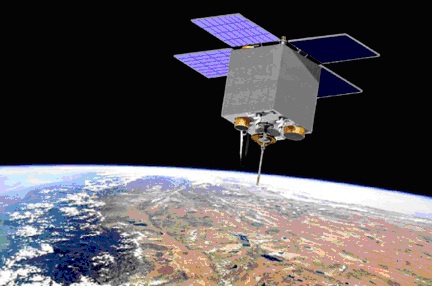
Within this research area, we address critical challenges in developing reliable software for precision control systems of current and next-generation spacecraft (SC). Building on recent advances in control theory, the project aims to create a versatile mathematical framework and advanced control methods, including algorithms and software powered by cutting-edge information technologies. These tools will be implemented in a specialized computing complex (CC) designed to provide intelligent support for SC control systems. This approach is expected to significantly reduce both the financial costs and development time for modern and future spacecraft.
High-precision algorithms and software for reliable autonomous navigation and attitude control systems will enable next-generation multifunctional spacecraft to effectively address a wide range of tasks in exploring space and the Solar System, as well as monitoring Earth.
Research in this area has been conducted by the department since 2007 under commissions from the National Space Agency of Ukraine (NSAU) and the National Academy of Sciences of Ukraine (NASU).
A comprehensive project has been developed to create high-precision, reliable navigation and attitude control systems for various types of SC. The project team includes experts from the Space Research Institute of the NASU and the NSAU, as well as specialists from the “Khartron” Research and Production Association. “Khartron”, a leading enterprise of the former USSR, played a key role in developing control systems for rocket and space technology, including the SS-18 and SS-19 intercontinental ballistic missiles. Leveraging the corresponding mathematical framework, “Khartron” specialists developed the first version of a specialized computing complex (CC). This system was successfully implemented in the autonomous navigation and attitude control system for the EgyptSat-1 satellite. Developed by Ukraine’s space industry for the Government of Egypt, EgyptSat-1 demonstrated successful operational performance after being launched into its designated Earth orbit.
Project Objective: Enhancing Navigation and Control Performance, namely:
- enhancing the accuracy of navigation and control systems through the improvement of algorithms for processing (filtering) direct measurement data from onboard sensors;
- maintaining the operational capability of spacecraft (SC) control systems in the event of partial measurement data failures;
- development of methods for autonomous detection of faults (abnormal situations) in measurement and actuation devices, including their localization and the reconfiguration of corresponding algorithms;
- increasing the level of autonomy for Earth observation spacecraft by expanding the range of tasks solved by the onboard control complex. This includes, in particular, the generation of attitude control programs and the activation of observation instruments based on target area and imaging mode data uplinked from the ground control station;
- development of robust control algorithms that guarantee the stability of spacecraft (SC) attitude systems, even when there is a significant discrepancy between the spacecraft’s actual dynamic properties and the mathematical models used in the control algorithms.